


 SkilzHub Certification
 Adobe Certification
 Google Certification
 Meta Certification
 Semrush Certification
 Hubspot Academy Certification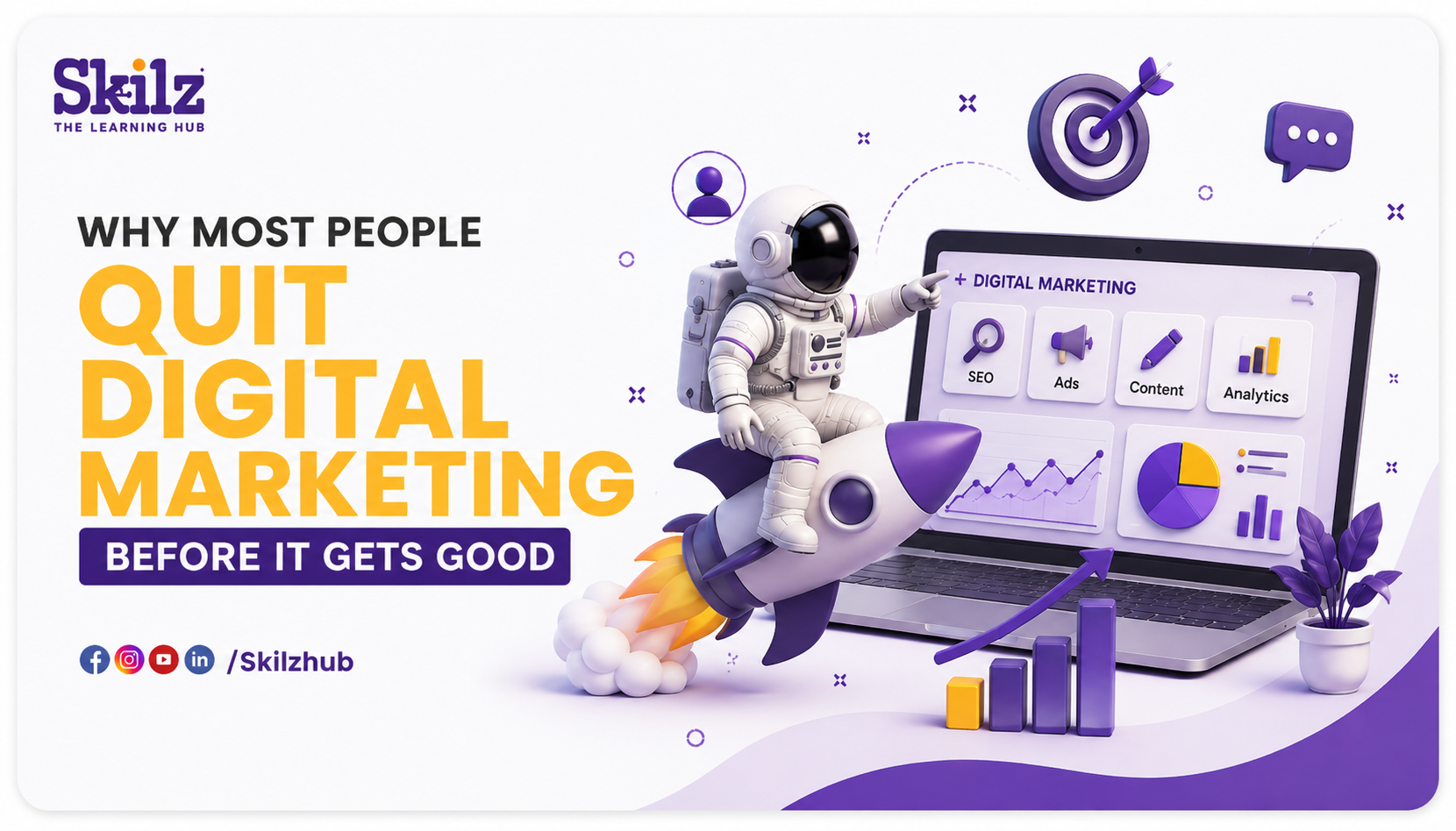
Why Most People Quit Digital Marketing Before They Actually Get Good
“You opened YouTube. Watched tutorials. Took notes. Saved videos you promised yourself you would revisit later.
For a few days, it felt productive.
Then everything slowed down.
No consistency. No direction. No practical skills. Just confusion mixed with motivation that faded faster than expected.”
This is where most beginners quit digital marketing.
Not because digital marketing is too difficult. Not because they are not smart enough. Most people quit because they are learning in a broken way.
And that changes everything.
Digital Marketing Is Not the Problem
People often say digital marketing feels overwhelming. But usually, the real problem is not the subject itself. It is the way they try to learn it.
Many beginners jump into SEO, Google Ads, Meta Ads, content marketing, social media marketing, email marketing, analytics, and copywriting all at the same time.
That approach destroys clarity.
Digital marketing has structure. Campaigns follow logic. Search engines follow patterns. Social media platforms reward strategy and consistency.
But when someone consumes endless information without applying anything, everything starts blending into noise.
Watching content is not the same as building skills.
The Real Reasons Most Beginners Fail in Digital Marketing
1. They Start Without a Clear Goal
Most people begin with the wrong question.
They ask, “What should I learn first in digital marketing?”
A better question is, “What am I trying to achieve?”
Do you want a digital marketing job? Freelance clients? A personal brand? Business growth?
Each path requires a different strategy.
Without a clear direction, beginners learn everything broadly but master nothing deeply.
That creates surface-level knowledge with zero practical confidence.
2. They Watch More Than They Execute
This is the biggest trap in online learning.
Tutorials feel productive because your brain mistakes consumption for progress.
But practical execution is what builds real digital marketing skills.
Running a small Meta Ads campaign teaches more than watching five hours of Facebook Ads theory.
Building a website teaches more than endlessly studying SEO basics.
Creating content teaches more than saving Instagram marketing reels.
Execution creates understanding. Theory alone does not.
The marketers who grow fast are usually the ones testing, failing, improving, and repeating consistently.
3. They Learn Without Feedback
Learning digital marketing alone can become painfully slow.
Not because you lack talent, but because you cannot identify your own mistakes early.
You may spend hours building an ad campaign with weak targeting or poor copywriting without even realizing it.
Without feedback, bad habits become permanent habits.
This is why mentorship, peer groups, internships, and live project training matter so much in digital marketing education.
A strong learning environment shortens the learning curve dramatically.
4. They Expect Fast Results
Digital marketing is a compound skill.
At first, progress feels invisible.
The first month feels confusing. The second month feels slightly better. Then suddenly, things begin to connect.
You start understanding audience targeting. Campaign optimization becomes clearer. Analytics finally make sense.
But most people quit before reaching that stage.
They want immediate results from a skill that rewards long-term consistency.
The truth is simple.
Digital marketing rewards patience more than motivation.
5. They Learn Outdated Strategies
A huge amount of free online content is outdated.
Algorithms change constantly. SEO ranking factors evolve. Advertising platforms update features every few months.
What worked in 2021 may not work today.
That is why current industry exposure matters.
If your learning system is outdated, your skills will be outdated too.
Modern digital marketing requires a practical understanding of content strategy, paid advertising, audience psychology, analytics, search intent, and platform behavior.
The industry moves fast. Learners must move with it.
What Actually Works in Digital Marketing Learning
People who successfully build careers in digital marketing usually follow the same pattern.
First, they learn step by step instead of trying to master everything together.
They focus on fundamentals first. Then SEO. Then social media marketing. Then analytics and paid ads.
Second, they work on real projects.
Not a fake theory. Real execution.
A small business page. A simple website. A practice ad campaign. A content strategy for a local brand.
Real projects build confidence and practical experience.
Third, they stay connected to a learning community.
Growth becomes easier when you receive corrections, accountability, and practical guidance from others.
Isolation slows learning more than most people realize.
What Separates a Beginner From a Professional
Knowing what a conversion funnel is will not get you hired.
Building one might.
Today, companies care less about certificates and more about proof of skill.
Someone who has managed real campaigns and understands campaign performance is far more valuable than someone who has only completed online modules.
That is why live projects and hands-on digital marketing training matter so much.
They turn learners into practitioners.
Should You Try Again
If you quit digital marketing before, that does not mean you failed.
It usually means your learning environment lacked structure, practical execution, and guidance.
Digital marketing is not reserved for geniuses or experts.
It is a skill built through consistency, real application, feedback, and adaptation.
The people who succeed are rarely the smartest in the room.
They are simply the ones who stayed long enough to become dangerous with the skill.





Comments (0)
Please login to leave a comment.
No comments yet. Be the first to comment!